
Facial fat grafting
Restores lost volume to the face with the patient's own fat.
The operation
One of the most visible changes to the face as we age is the change in volume. Typically the cheeks, temples and under-eye area lose volume and look hollow, which makes the face look older and saggy. In the early stages fillers can be used to good effect. As the changes become more noticeable, other options such as fat transfer (fat grafting) may be more appropriate.
Fat transfer removes fat from one place by liposuction and injects it into another area to add volume and improve its shape. Fat also has the potential to regenerate the surrounding tissue, including the skin over it. Fat grafting is very effective for treating some types of facial asymmetry.
During his training Mr West was awarded a PhD by the University of Edinburgh for his research on stem cells within fat and their regenerative potential. His work received prizes from the British Association of Plastic, Reconstructive and Aesthetic Surgeons and the European Association of Plastic Surgeons. Based on this research, Mr West routinely uses fat grafting as part of his approach to total facial rejuvenation, restoring youthful volume during facial plastic surgery and facelifts.
Fat transfer can be performed alone or together with other procedures to rejuvenate the face, such as a facelift, a lip lift or blepharoplasty. It can give long-lasting, natural results for patients looking to restore volume to their face.
- In theatre
- 1 to 2 hours
- Anaesthetic
- Local
- Downtime
- 1 week
- Exercise
- 2 weeks
- Price
- From £1,995
- Suited to
- Volume loss, deep folds and facial asymmetry.
- How it works
- Small volumes of fat are removed by liposuction, then injected to restore volume and rejuvenate the tissues.
- The result
- A natural, youthful look, from restored volume and regenerated tissue.
Step by step
From the first consultation to your recovery.
Your consultation
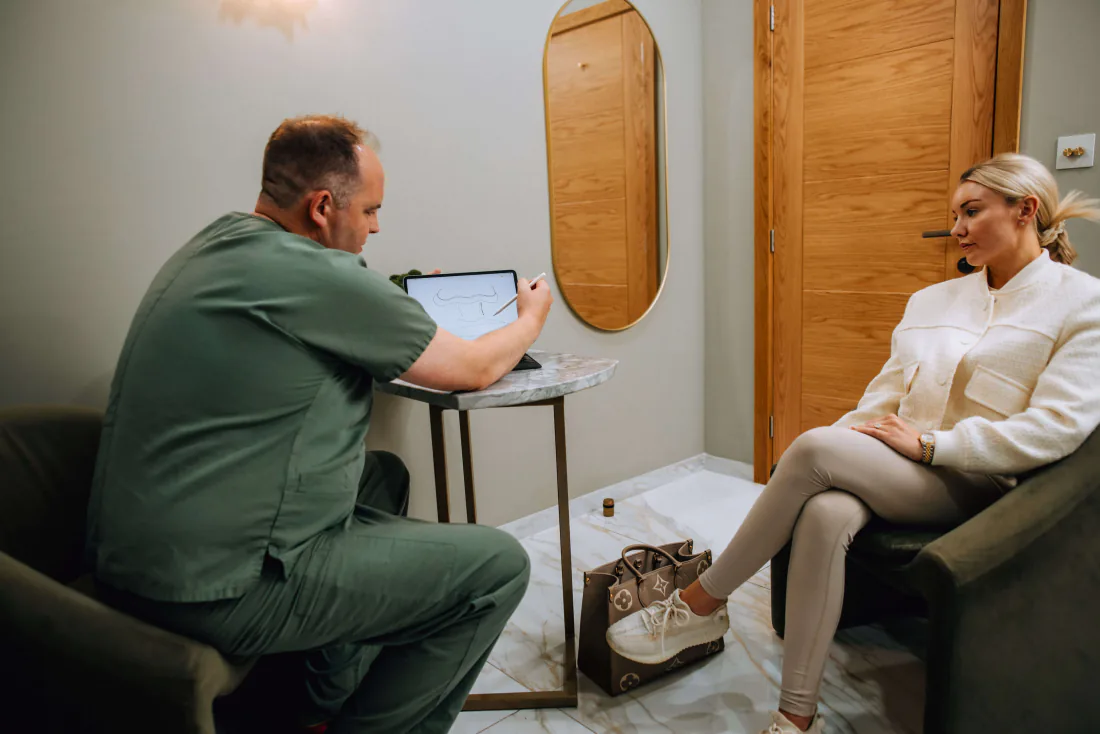
Book a consultation online or call the team. Consultations are in York and Leeds, with virtual consultations for patients travelling from further afield.
The day of surgery
The team will welcome you to the clinic and get you settled. We go through the procedure, discuss the process and sign the consent form. Photographs are taken before you head to theatre.
Mr West marks the areas to be treated before surgery. Local anaesthetic is injected into the fat donor site, which stings for a few seconds. Fat is removed through small incisions with a small cannula, then transferred to the areas of the face that need more volume. It is injected through very small incisions in multiple thin lines. The skin is usually closed with a small dissolvable stitch and Steri-Strips (thin plasters) are applied over the scars.
Recovery
Following surgery you will be transferred to the recovery area and looked after by our dedicated recovery team. We will make sure all aftercare is explained and follow-up appointments are arranged before you leave.
What patients say
Reviews from Mr West's Google profile, published as written.
Frequently asked questions
The questions patients ask most often. Anything specific to one patient is covered at the consultation.
Will all the fat injected stay?
There is some initial swelling that settles over the first week. The injected fat needs to develop a blood supply to survive and typically 50 to 70% of it does. This fat is then permanent and behaves like the other fat in your face. Any significant change in weight will affect it. As you age the fat will naturally reduce in volume.
Is one treatment enough?
Not all the injected fat remains, so more than one initial treatment is often needed. As we naturally age and lose more volume, top-ups may be needed.
What are the follow-up or aftercare procedures?
Wounds are usually checked 7 to 10 days after surgery. A further review appointment is made for 4 to 6 weeks after surgery.
When can I start playing sports again?
Light activity is fine after 1 week. Vigorous exercise should be avoided for at least 2 weeks.
Can fat grafting be used to treat asymmetry?
Yes. Fat grafting can be a very effective treatment for facial asymmetry.
Can fat grafting rejuvenate tissue?
There has been a great deal of research into the regenerative properties of fat and Mr West was awarded a PhD for his research into this subject. There is good clinical data showing that fat grafting can help regenerate tissues and soften areas of tight scar tissue.
Book a consultation
A consultation with Mr West covers the anatomy, what surgery can realistically achieve and the risks involved. A fixed written quote follows afterwards.
Surgery is only planned after this assessment, with time to reflect before any decision. Virtual consultations are available for patients travelling from further afield.
Keep up to date
Mr West's advice articles, sent once a month by email.
This site is protected by reCAPTCHA and the Google Privacy Policy and Terms of Service apply.